
Most RO water purifiers in India are designed to remove harmful contaminants such as heavy metals, bacteria, and dissolved salts.
However, many conventional RO systems also remove essential minerals like calcium and magnesium, leaving the water overly purified and often flat in taste. Drinking completely demineralized water for long periods may not provide the balanced mineral content that healthy drinking water should have.
The Homvel RO Water Purifier with Digital TDS Controller addresses this problem by combining advanced purification with intelligent mineral balance. Instead of removing everything, the system carefully adjusts the Total Dissolved Solids (TDS) level to keep water both safe and naturally balanced.
In this guide, you’ll learn what TDS actually means, why many ordinary RO purifiers over-purify water, how Homvel’s digital TDS controller technology works, and why it may be considered one of the most advanced RO systems for Indian households.
Table of Contents
What Is TDS and Why Should You Care?
TDS (Total Dissolved Solids) refers to the total concentration of dissolved substances present in water. These substances include naturally occurring minerals, salts, and trace metals that dissolve as water passes through soil, rocks, and pipelines. TDS is measured in parts per million (ppm), which indicates how many milligrams of dissolved solids are present in one liter of water.
Common elements that contribute to TDS include:
- Calcium
- Magnesium
- Sodium
- Potassium
- Chlorides
- Bicarbonates
Not all dissolved solids are harmful. In fact, some minerals like calcium and magnesium are beneficial for health and also improve the taste of drinking water. However, excessively high TDS levels may indicate the presence of unwanted contaminants such as heavy metals, industrial chemicals, or excessive salts.
Monitoring TDS is important because it helps determine whether water is safe, balanced, and pleasant to drink. Very low TDS water may taste flat and lack essential minerals, while very high TDS water can taste salty or bitter and may require purification.
TDS Level vs Water Quality
| TDS Level (ppm) | Water Quality |
|---|---|
| 0–50 | Very low mineral content |
| 50–150 | Ideal drinking water |
| 150–300 | Acceptable quality |
| 300–500 | High TDS – purification recommended |
| 500+ | Unsafe without purification |
According to the World Health Organization (WHO) and the Bureau of Indian Standards (BIS) drinking water guidelines, water with moderate mineral content generally provides the best taste and balance for regular consumption.
The BIS drinking water standard IS 10500 suggests that the acceptable TDS limit for drinking water is up to 500 ppm, while the desirable range for good taste and health is typically between 50 and 150 ppm.
This is why modern RO purifiers with TDS control technology are becoming increasingly important. They allow households to remove harmful contaminants while still maintaining the right level of beneficial minerals in drinking water.
The Problem with Ordinary RO Purifiers
Reverse Osmosis (RO) technology is widely used in India to remove contaminants like heavy metals, bacteria, and dissolved impurities from water. While this purification process is effective at making water safe to drink, most traditional RO purifiers come with a major drawback — over-purification.
Standard RO systems are designed to remove almost everything dissolved in water, including both harmful contaminants and beneficial minerals. During the filtration process, the RO membrane blocks impurities such as lead, arsenic, and excess salts. However, it also removes naturally occurring minerals like calcium, magnesium, and potassium, which are important for taste and overall water quality.
As a result, many households end up drinking demineralized water, which often tastes flat or slightly acidic. Over time, consistently consuming mineral-stripped water may not provide the balanced mineral content typically recommended for healthy drinking water.
Another issue with ordinary RO systems is that they focus mainly on purification but lack smart control or monitoring features. Most units operate blindly without giving users any visibility into the water quality or filtration performance.
5 Common Failures of Standard RO Systems
Here are some of the most common limitations found in conventional RO purifiers:
- No TDS Control
Most basic RO purifiers cannot regulate the Total Dissolved Solids (TDS) level after purification, which can result in water with extremely low mineral content. - No Mineral Balance
Traditional systems remove both harmful substances and beneficial minerals, leaving water with little to no natural mineral composition. - No Real-Time Water Monitoring
Users often have no way to check the input or output water quality because standard purifiers lack digital displays or smart monitoring. - Storage Tank Bacterial Risk
In many purifiers, purified water sits in a storage tank for hours, creating a potential environment for bacterial regrowth if there is no continuous protection system. - Poor Water Recovery Ratio
Conventional RO purifiers can waste a significant amount of water during filtration, sometimes rejecting three to four liters for every liter of purified water produced.
Because of these limitations, modern water purification technology is shifting toward smart RO systems that maintain mineral balance while ensuring safe filtration. In the next section, we’ll look at how Homvel RO purifiers are designed specifically to solve these challenges.
Homvel RO — Built for India’s Water Reality
India’s drinking water conditions vary widely from region to region. In many parts of North India, groundwater often contains high levels of TDS (Total Dissolved Solids) due to minerals, salts, and other dissolved substances present in underground sources.
In metropolitan cities, municipal water supply may fluctuate in quality depending on treatment efficiency, pipeline conditions, and seasonal demand. During monsoon months, contamination risks can also increase due to surface runoff entering water sources.
Because of these challenges, a one-size-fits-all purification approach does not always work effectively in Indian households. Many conventional RO purifiers rely on aggressive filtration that removes not only harmful contaminants but also essential minerals, leading to overly purified water with poor taste.
Homvel RO water purifiers are designed specifically for India’s complex water conditions. Instead of focusing solely on heavy purification, Homvel emphasizes precision purification — ensuring harmful impurities are removed while maintaining a balanced mineral content for safe and healthy drinking water.
One of the most advanced models in the lineup is the Homvel Intell Plus RO, engineered to deliver intelligent water purification with modern monitoring features.
Key highlights of the Homvel Intell Plus RO include:
- Digital TDS Controller that helps maintain optimal mineral balance in drinking water
- Smart monitoring system that provides real-time information about purification performance
- Multi-stage filtration technology designed to remove contaminants while preserving water quality
- Advanced safety and purification features suited for varying Indian water conditions
If you want to explore the complete specifications and features of this model, you can visit the official product page here:
👉 Homvel Intell Plus RO Water Purifier – View details on the official Homvel website.
How the Digital TDS Controller Works
A Digital TDS Controller is one of the most important technologies in modern RO water purifiers. Instead of simply removing all dissolved solids, it intelligently balances purified water with natural minerals to produce healthier drinking water.
Traditional RO systems often reduce TDS to extremely low levels, which can remove beneficial minerals such as calcium and magnesium. Homvel’s digital controller solves this problem by precisely regulating the mineral content in the final drinking water.
Let’s understand how this process works.
The Blending Mechanism
Inside the purifier, water follows two parallel purification paths before reaching your glass.
1️⃣ RO Purification Path
In the first path, water passes through the RO membrane, which removes harmful contaminants such as heavy metals, salts, and bacteria. This process produces highly purified water but with very low mineral content.
2️⃣ Mineral Bypass Path
In the second path, a small portion of water bypasses the RO membrane while still passing through pre-filtration. This stream retains natural minerals that are important for taste and health.
The Digital TDS Controller then blends these two streams in the correct proportion to achieve the desired TDS level. By controlling this blending process, the purifier ensures that the output water is both safe and mineral-balanced.
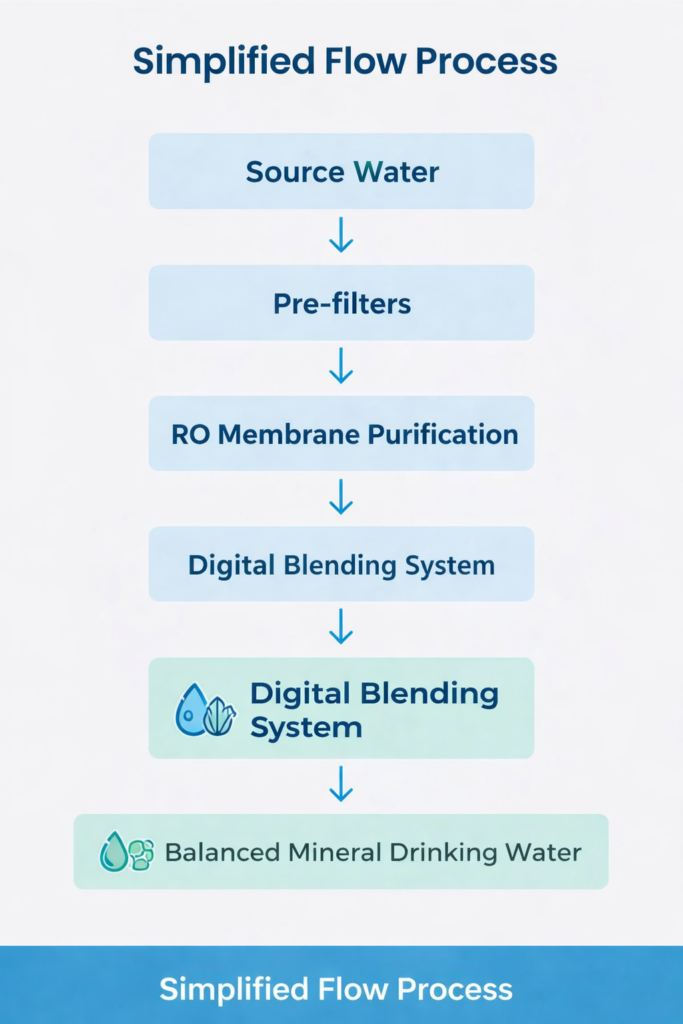
This intelligent blending ensures the final water stays within the ideal drinking range of around 50–150 ppm, delivering both purity and better taste.
What Makes Homvel’s Version “Digital”?
Most standard RO purifiers in the market use a manual TDS controller, which is usually a small screw valve adjusted by a technician during installation. Once set, it rarely adapts to changes in input water quality.
The problem is that water TDS levels can vary throughout the year, especially in Indian cities where municipal supply and groundwater sources fluctuate.
Homvel solves this limitation with a fully digital TDS control system that automatically manages mineral balance using smart sensors and electronic control.
Instead of manual adjustments, the purifier continuously monitors water quality and automatically maintains the target TDS level.
Comparison: Manual vs Digital TDS Controller
| Feature | Manual Controller | Homvel Digital Controller |
|---|---|---|
| Real-time TDS display | ❌ | ✅ |
| Auto-adjustment | ❌ | ✅ |
| Programmable TDS | ❌ | ✅ |
| Service alerts | ❌ | ✅ |
| Password protection | ❌ | ✅ |
Because of this automation, the Homvel Digital TDS Controller delivers more consistent water quality, reduces dependency on manual calibration, and provides smarter monitoring for users.
In simple terms, it transforms a traditional RO purifier into a smart water purification system designed for modern households.
Key Features of Homvel RO Water Purifier
Digital TDS Controller
Maintains ideal mineral balance by automatically adjusting water TDS levels.
24×7 UV Tank Protection
Continuous UV sterilization keeps stored water safe from bacteria and microbes.
Smart TDS Auto-Adjustment
Automatically balances purified and mineral water for perfect drinking quality.
6–7 Stage Filtration
Multi-layer purification removes heavy metals, chemicals, bacteria, and viruses.
Filter Life Indicator
Smart alerts notify you when filters need replacement for optimal performance.
RO Membrane Auto-Flush
Automatically cleans the membrane to extend life and maintain purification efficiency.
High Water Recovery System
Advanced design reduces water wastage compared to traditional RO purifiers.
Mineral Balanced Output
Ensures healthy drinking water with ideal TDS levels between 50–150 ppm.
Smart Service Alerts
Digital monitoring system provides timely service reminders.
Compact Modern Design
Stylish wall-mounted purifier designed to fit modern kitchens.
Why 24×7 UV Tank Protection Is Important
Many RO water purifiers successfully remove impurities during filtration but fail to protect the water once it is stored inside the purifier tank. In such cases, bacteria and microbes can slowly grow inside the storage tank, especially when the water remains unused for several hours.
This is where 24×7 UV Tank Protection becomes extremely important. A built-in UV lamp continuously disinfects stored water to maintain its purity even after the purification process is complete.
How UV Protection Keeps Water Safe
- ✔ Prevents microbial growth inside the storage tank
- ✔ Protects purified water from secondary contamination
- ✔ Eliminates odor-causing bacteria
- ✔ Keeps stored water hygienic for longer periods
In warm and humid climates like India, bacterial growth can occur faster in stored water. Continuous UV protection ensures that the water inside the purifier remains safe, fresh, and hygienic every time you use it.
Homvel RO vs Standard RO Purifiers in India
Most traditional RO purifiers focus only on filtration. Homvel RO goes a step further by combining advanced purification with smart monitoring and mineral balance technology. The comparison below shows how Homvel stands apart from typical RO purifiers available in the market.
| Feature | Standard RO Purifier | Homvel RO Water Purifier |
|---|---|---|
| TDS Control | Manual adjustment | Digital TDS Controller |
| Mineral Balance | Limited control | Precise mineral balancing |
| UV Tank Protection | Available in some models | 24×7 UV tank protection |
| Smart Alerts | ❌ Not available | ✅ Filter & service alerts |
| Real-Time Monitoring | ❌ Not available | ✅ Live TDS display |
Who Should Buy Homvel RO?
Homvel RO is ideal for:
- Families in North India (UP, Punjab, Haryana, Rajasthan) with high-TDS groundwater
- Urban households with municipal supply where TDS varies seasonally
- Health-conscious consumers who understand the importance of mineral balance in water
- People with children or elderly members at home who need reliably safe water
- Anyone who has previously owned a standard RO and noticed flat-tasting, demineralized water
What the WHO and BIS Say About Drinking Water TDS
Understanding the recommended TDS (Total Dissolved Solids) levels in drinking water is important for maintaining both safety and mineral balance. Two major authorities that provide guidance on drinking water quality are the World Health Organization (WHO) and the Bureau of Indian Standards (BIS).
WHO Guidelines on Drinking Water Minerals
According to the World Health Organization (WHO), extremely low-mineral water — often produced by aggressive purification systems such as reverse osmosis — may not always be ideal for long-term consumption.
Water naturally contains beneficial minerals like:
- Calcium
- Magnesium
- Potassium
- Bicarbonates
When these minerals are completely removed, the water may taste flat or slightly acidic and may not provide the same mineral balance found in natural drinking water sources.
For this reason, many modern purification systems now focus on mineral retention or controlled remineralization rather than removing everything from the water.
BIS IS 10500 Drinking Water Standards
In India, drinking water standards are defined under BIS IS 10500.
For TDS levels, BIS suggests:
| TDS Level (ppm) | Water Quality |
|---|---|
| Up to 500 ppm | Acceptable drinking water |
| 500–2000 ppm | Permissible in absence of alternate source |
| Above 2000 ppm | Not recommended for drinking |
However, many water quality experts suggest that balanced drinking water typically tastes best and remains healthiest between 50–150 ppm, where beneficial minerals are present but harmful contaminants remain filtered out.
How Homvel Maintains the Ideal TDS Range
The Homvel RO Water Purifier with Digital TDS Controller is designed to maintain this mineral balance automatically.
Instead of producing completely demineralized water, the system uses intelligent blending technology:
- Water first passes through the RO membrane to remove contaminants.
- A controlled mineral stream is then blended back into the purified water.
- The digital TDS controller adjusts the ratio automatically to maintain the desired output level.
This ensures the final drinking water typically stays within the 50–150 ppm mineral-balanced range, providing both purity and natural taste.
In simple terms, Homvel doesn’t just purify water — it optimizes it for healthier daily consumption.
How to Set the Right TDS on Your Homvel RO
Setting the correct TDS (Total Dissolved Solids) level ensures that your drinking water is both safe and mineral-balanced. The digital TDS controller in Homvel RO allows you to precisely adjust the mineral content in purified water based on your source water quality.
Follow these simple steps to configure the ideal TDS level.
Step-by-Step Guide
1. Check the Input Water TDS
Before adjusting the purifier, measure the TDS level of your incoming water supply. Many Homvel models show the input TDS on the display panel, or you can use a handheld TDS meter.
2. Access the Digital Settings Panel
Open the control interface on the Homvel RO unit. Navigate to the TDS control or mineral balance settings from the digital display panel.
3. Set Your Desired Output TDS
Choose the target TDS level you want for drinking water. The recommended range for healthy mineral balance is typically between 75–150 ppm.
4. Automatic Blending Adjustment
Once the target TDS is set, the system automatically adjusts the blending ratio between RO-purified water and mineral-rich bypass water. This ensures consistent mineral balance without manual tuning.
5. Monitor Through the Live Display
The real-time digital display shows the current output TDS level, allowing you to monitor water quality anytime and make adjustments if needed.
Recommended TDS Range
For most households, the ideal drinking water TDS level is:
75–150 ppm
This range maintains a good balance between purity and essential minerals, providing water that is both healthy and pleasant in taste.
Maintenance Tips for Your Homvel RO
Keeping your Homvel RO Water Purifier well maintained ensures consistent water quality, better filtration efficiency, and a longer lifespan for internal components. Regular maintenance also helps maintain the ideal mineral balance and TDS levels in your drinking water.
Below are some simple maintenance practices every Homvel user should follow.
✔ Maintenance Checklist for Your Homvel RO Purifier
Regular maintenance keeps your Homvel RO purifier performing at its best. Follow this simple checklist to ensure clean, safe, and mineral-balanced drinking water.
Change Pre-Filters Every 3–6 Months
Pre-filters remove dust, sand, and sediment before water reaches the RO membrane. Replacing them every 3–6 months prevents clogging and maintains strong filtration performance.
Replace RO Membrane Every 2–3 Years
The RO membrane is the core purification component that removes dissolved salts, heavy metals, and contaminants. Over time, its efficiency decreases, so replacing it every 2–3 years ensures optimal purification.
Annual UV Lamp Replacement
Homvel purifiers equipped with UV protection require periodic UV lamp replacement to maintain effective bacterial and microbial protection. An annual replacement is typically recommended.
Use Built-In Digital Service Alerts
Homvel’s smart system includes digital service notifications that alert users when filters or components need replacement. Always follow these alerts to maintain peak purifier performance.
Run Monthly Auto-Flush Cycle
Running the auto-flush function once a month helps clean the RO membrane and prevents mineral buildup. This improves membrane life and keeps water flow consistent.
Recalibrate After Monsoon Season
Water quality often changes during the monsoon due to increased contaminants and fluctuating TDS levels. Recalibrating the TDS settings after the monsoon helps maintain the ideal mineral balance.
By following these simple maintenance steps, your Homvel RO purifier will continue delivering safe, pure, and mineral-balanced drinking water for years to come.
Where to Buy Homvel RO Water Purifier
Explore the latest Homvel RO models and compare features to choose the perfect water purifier for your home. Visit our product pages below to learn more and make an informed decision.
Don’t Just Purify. Purify Smartly.
Water purification should not just remove harmful impurities. It should also preserve the natural minerals that are essential for healthy drinking water.
With its Digital TDS Controller, Homvel RO ensures that every glass of water maintains the perfect balance between purity and essential minerals.
Instead of over-purifying water like many traditional RO systems, Homvel intelligently adjusts the mineral level to deliver water that is both safe and naturally balanced.